So it is getting to the time of year to start thinking about fall beers. For the past 4 years I have been doing a Pumpkin ale cause that's the thing to do. Last year I pulled a 3rd place medal for this beer at the Peterson Air force Base Homebrew Competition. This is one of those recipes that is pretty much the same from the first time I designed it. There have been tweaks here and there but what I was going for in the first place is still the base.
Like most pumpkin ales I thought about pumpkin pie and what I liked about it. The best pumpkin pie is spiced, but not too much, and the crust brings and toasty, bready, graham like greatness to it. The most important part of all is that the pumpkin is evident and you are not just tasting spice.
I think I may be the first to use pumpkin in this way in the brewing process. I have not heard of anyone else using the process that I do and try to tell people that it seems to do the trick of giving you some actual pumpkin flavor.
Some people will tell you that using pumpkin is useless and it's the spice that gives a pumpkin ale it's characteristics...well, I am in the boat that says using actual pumpkin does give some sort of depth and if I am going to call it a pumpkin ale then I am going to use pumpkin.
This year there were a few tweaks from last year. One that I meant to make was that I changed the American 2-row malt to British Maris Otter malt in the same amount. One that was not planned is that instead of using plain pumpkin from the can, I had a few cans of Pumpkin pie mix in the cabinet that were bought by mistake for my dog's digestion problems, so I decided to use those instead. Basically it's canned pumpkin with the spices already mixed in. I think the Maris Otter malt will give me a better malty backbone to the beer, and I don't think the pumpkin pie mix will change the end product that much. I may just have to adjust the spice addition in the secondary a little.
So on with the show:
This first step is to cook the pumpkin. Whether using the pumpkin pie mix or the plain pumpkin, bake it in the oven at 350 degrees for about one hour. This will caramelize some of the sugars and give the flavor more complexity. Plus it makes your kitchen smell like thanksgiving day in August.
Next step is to heat up your mash water. I use the calculator on promash to decide for me where my water temperature needs to be to make me hit my mash temperature. One trick I learned rather than figuring out your mash tun's thermal mass is to heat the water up higher, then let the mash tun heat up and let the water cool until you have the temp you are looking for. I was looking for 162 so I heated the water to 170, dumped it in the tun, and let it sit for about 10 minutes, monitoring it until I got the temp I wanted to add my grain to.
I added my grain to the water and stirred away. Remember to do this slowly as to miss making grain balls. Grain balls will hurt your efficiency as they will not be converted since the insides will not be touched by the hot water.
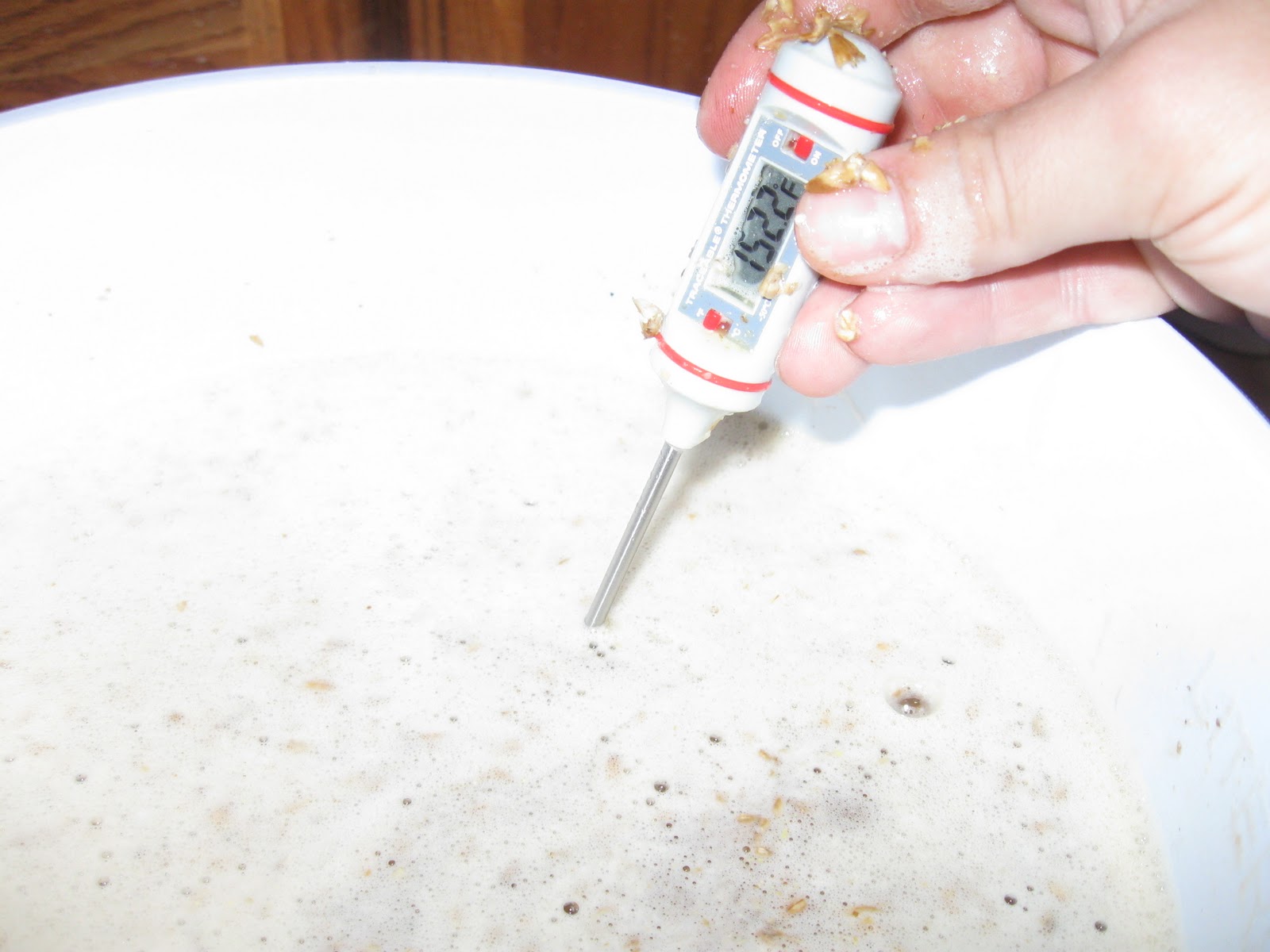
After stirring all my grain in, I put the top on and let the temperature stabilize throughout the mash. After about 5-10 minutes I take the top off and check to see if I have hit the mash temp I wanted. For this beer I was looking at 152 degrees, and again the promash calculator has gotten me almost spot on.
While the mash is converting I heat my sparge water. When the sparge water reaches about 160 degrees Fahrenheit I add my pumpkin mix. This is the part of the process that I have not seen used before. I believe adding pumpkin straight to the mash does not give the final product any pumpkin flavor, and if you add pumpkin straight to the boil it makes the beer way too cloudy and seems to turn out too vegetable like. When using pumpkin in this way the sparge water soaks up the flavor and the pumpkin is easily strained by the grain bed when sparging. I guess this process would only be useful for batch spargers only, as this would probably clog up a fly sparging system.
The first runnings came out beautiful. Great orange copper color, exactly what I was looking for.
While my first runnings come out of the mash tun, my sprage water is stewing with the pumpkin mix picking up that great pumpkin flavor.
I add the sparge water and let it pick up the remaining sugars off the grain.When all the extra wort is collected I put it on the fire.
From the picture shown above you can somewhat see how the pumpkin mix is strained out through the grain bed. You are not left with a ton of pumpkin mush in the boiling wort.
When the worth reaches a boil the first hop addition goes in. Being a pumpkin ale this is not supposed to be hopped up, but these additions are crucial in balancing the flavors out.
With a small amount of time left in the boil I add the spice mixture (which I will show below), add it late so the aromatics are not boiled off.
This is pretty much the last step in this brew except for the cooling and transferring to the fermenter. I assume anyone reading this already knows these steps and can do it without pictures.
Here is the recipe:
Grain Bill:
6 lbs Crisp Maris Otter
2 lbs Weyermann Munich II
1 lb Castle Biscuit malt
1 lb Simpson Light crystal malt
4 oz Castle Special B
Mash w/ 14 qts water @ 152 degrees for 1 hour 30 minutes
2 - 15oz cans of pumpkin pie mix baked at 350 degrees for 1 hour. Let sit for 60 - 90 minutes.
Heated sparge water to 160 degrees and added pumpkin pie mix.
Hops:
.75 oz US Perle (whole) 7.5AA 60 min
.5 oz US Golding (pel) 4.5 AA 30 min
Spice:
1 1/2 tablespoon spice mix:
- 4 tablespoon Cinnamon
- 3 1/2 Teaspoon Nutmeg
- 3 teaspoon Allspice
- 4 teaspoon ground ginger
- 1 1/2 teaspoon ground clove
Yeast:
Safale 04 - English Ale - 1 packet (dry yeast, but it's worked the best in this recipe)
set fermenter at 60 degrees
After about 12 hours the fermentation has started nicely. I will post back with the next steps of this recipe.